

VR Driving Simulators in Egypt: Safer Training and Smarter Licensing
Driver training in Egypt has to prepare people for dense traffic, different road behaviors, roundabouts, highways, pedestrians, and unexpected hazards. A VR driving simulator gives learners a safe environment to practise scenarios that are difficult or risky to repeat on public roads.
Why simulation matters for driver training
Traditional driving lessons are essential, but they cannot expose every learner to the same conditions. One learner may practise in calm traffic, while another faces difficult situations. This makes assessment less consistent.
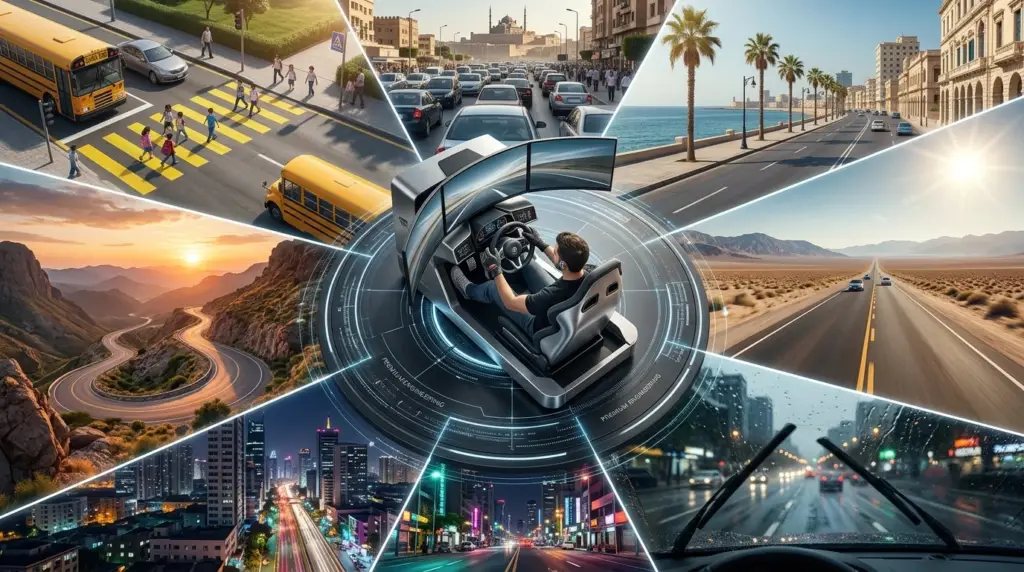
A simulator can place every learner in the same controlled scenarios: lane changes, sudden braking, night driving, fog, emergency vehicles, roundabouts, and hazard perception. This helps schools and authorities evaluate decisions more objectively.
What a VR driving simulator can measure
A well-designed simulator can track speed control, lane discipline, reaction time, braking behavior, mirror checks, sign recognition, and hazard response. Instead of relying only on memory or observation, the training team receives data on how the learner actually behaved during the scenario.
For licensing use cases, this data can support examiners with clearer scoring and repeatable test conditions. For driving schools, it can help instructors focus lessons on each learner’s weakest areas.
How Metas approaches driving simulation
Metas’ simulation work includes training and licensing simulations that can replicate rules, tests, realistic physics, AI traffic, and digital twin environments. For Egypt, this means scenarios can be designed around local road context and Arabic-first instructions.
The simulator can be built for PC, mobile, or VR depending on the target audience, available hardware, and operational setup.
Where the simulator can be used
Potential users include driving schools, transport authorities, corporate fleets, logistics companies, universities, and public awareness programs. For fleet operators, simulators can also support refresher training for professional drivers and reduce the risk of unsafe habits.
Next step
Interested in safer driver training or modern licensing tools in Egypt? Contact Metas to discuss a VR driving simulator tailored to your training goals.
What to prepare before simulator development
Prepare the approved rules, test flow, scoring logic, training objectives, user roles, hardware expectations, and reporting needs. For Egypt, local road behavior, Arabic instructions, and examiner workflow should be considered early.
FAQs
Q: Can VR replace real driving lessons?
A: No. VR should support real driving, not replace it. It helps learners practise difficult or repeatable scenarios before or alongside road training.
Q: Can the simulator match Egyptian road conditions?
A: Yes. Scenarios can be designed around local traffic behavior, signs, roads, and training requirements.
Q: Is the simulator useful for fleet training?
A: Yes. Corporate and logistics fleets can use it for safety refreshers, hazard perception, and professional driver assessment.
Q: What devices can be used?
A: Depending on the design, the experience can run on PC, VR headset, or dedicated simulator hardware.