

Arabic AI Avatars in the UAE – Transforming Customer Service & Training
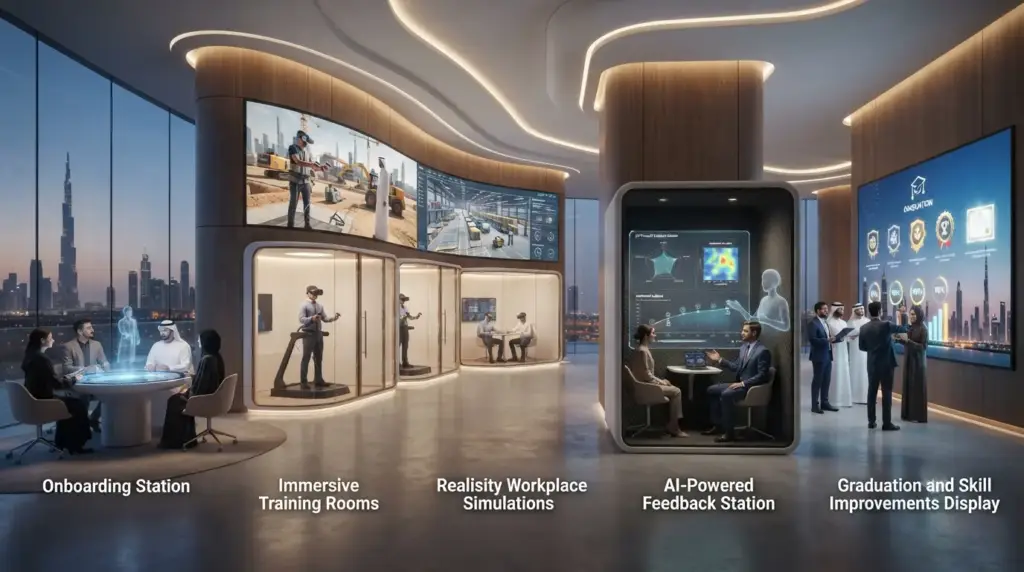
Corporate training in the UAE faces the dual challenge of maintaining global competitiveness while accommodating a diverse workforce. Virtual reality (VR) training provides immersive, engaging experiences that teach technical skills, safety procedures and soft skills. This article outlines strategies for implementing VR corporate training programmers across various industries and highlights the benefits.
Potential Training Scenarios
- Safety & Compliance: Simulate industrial accidents, fire drills and hazardous material handling for construction, manufacturing and energy sectors.
- Customer Service: Teach retail and hospitality staff to handle difficult customers, upsell products and provide outstanding service.
- Leadership Development: Managers navigate complex decision‑making scenarios, practising communication and conflict resolution.
- Technical Operations: Workers learn to operate machinery, assemble components or perform maintenance.
- Cultural Awareness: Multinational teams learn local customs and regulations to improve collaboration.
Strategies for Success
- Align Training with Business Goals: Identify KPIs such as reduced accidents, faster onboarding or increased sales.
- Start Small: Pilot a single module to prove effectiveness before scaling.
- Collaborate with Experts: Engage Metas and subject matter experts to design scenarios that reflect real‑world challenges.
- Ensure Accessibility: Provide alternative formats for employees who may experience motion sickness or have accessibility needs.
- Measure & Iterate: Collect performance data, feedback and ROI metrics. Update modules regularly to stay relevant.
Benefits for UAE Companies
- Higher Engagement: Interactive experiences capture attention better than traditional lectures.
- Improved Performance: Employees practise until they master tasks, leading to better real‑world performance.
- Reduced Training Costs: Once developed, modules can be reused across cohorts, saving on instructor and travel costs.
- Risk Reduction: Simulations allow practice of high‑risk tasks without endangering people or assets.
- Cultural Relevance: Localized content resonates with Emirati and expatriate employees.
FAQs
What hardware is required?
Stand‑alone VR headsets or PC‑powered devices, depending on the complexity of scenarios.
How long do modules take to develop?
6–12 weeks for most modules, depending on scope and complexity.
Can content be localized?
Yes. Voice‑overs, interfaces and scenarios can be customized for Arabic and other languages.
Is VR training suitable for all industries?
While some tasks benefit more than others, most industries can find valuable use cases.
FAQs for CMS
FAQ 1 Question: What hardware is required?
FAQ 1 Answer: Stand‑alone VR headsets or PC‑powered devices, depending on the complexity of scenarios.
FAQ 2 Question: How long do modules take to develop?
FAQ 2 Answer: 6–12 weeks for most modules, depending on scope and complexity.
FAQ 3 Question: Can content be localized?
FAQ 3 Answer: Yes. Voice‑overs, interfaces and scenarios can be customized for Arabic and other languages.
FAQ 4 Question: Is VR training suitable for all industries?
FAQ 4 Answer: While some tasks benefit more than others, most industries can find valuable use cases.
Call to Action
Ready to boost your corporate training effectiveness? Schedule a consultation with Metas-> to design custom VR training programmers for your UAE workforce.