

Immersive Safety Training in Egypt: Practical VR for Industrial Teams
Industrial safety training becomes more effective when workers can practise, not only listen. Immersive safety training uses VR, desktop simulation, or interactive 3D scenarios to let teams experience risky situations without placing people or equipment in danger.
Why safety training needs practice
A worker may understand a procedure in theory but still hesitate during an emergency. In factories, logistics sites, construction areas, and energy facilities, hesitation or wrong sequencing can create serious risk.
Immersive training helps employees rehearse important actions: checking protective equipment, identifying hazards, reporting incidents, evacuating safely, and following equipment shutdown steps.
What an immersive safety module looks like
A safety module can place the trainee inside a virtual worksite. The trainee might inspect the area, select the right tools, respond to an alarm, or choose the next step after seeing a hazard. The system then gives immediate feedback.
Depending on the need, the module can run on a VR headset, PC, training room screen, or tablet. VR is useful when spatial awareness matters, while desktop simulation can be better for scalable rollouts.
Use cases for Egyptian industrial companies
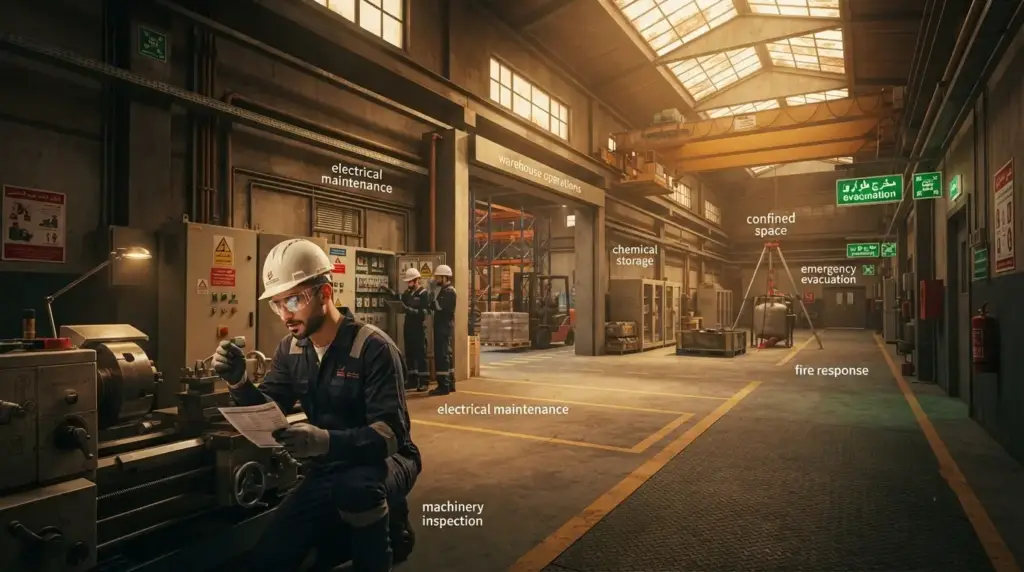
Relevant use cases include factory walkthroughs, machine safety, warehouse movement, fire response, chemical handling awareness, electrical hazards, PPE compliance, and contractor induction.
The same approach can support onboarding. New employees can explore a virtual version of the site before entering restricted areas.
What makes the training credible
The strongest safety simulations are built from real procedures, site photos, floor plans, and HSE input. The goal is not to create a generic game. It is to represent the company’s real risks and teach the correct behavior.
Metas combines real-time 3D, VR/MR, AI avatars, and serious games to build training experiences around clear business and learning goals.
Next step
If your safety training needs more practice and less passive learning, contact Metas to discuss an immersive safety training module for your team in Egypt.
What to prepare before safety simulation
Provide the safety procedure, hazard list, site references, PPE rules, decision points, and the reports HSE managers need after training. The more realistic the source material, the more credible the simulation becomes.
FAQs
Q: Can immersive safety training be customized to our facility?
A: Yes. It can be built around your layout, equipment, procedures, hazards, and safety language.
Q: Is VR required for every safety topic?
A: No. Some topics work better on desktop or mobile, while VR is best for spatial or high-risk scenarios.
Q: Can we track trainee performance?
A: Yes. Modules can track decisions, scores, completion, mistakes, and repeat attempts.
Q: Can it support Arabic content?
A: Yes. Arabic and English content can be included depending on the workforce.