

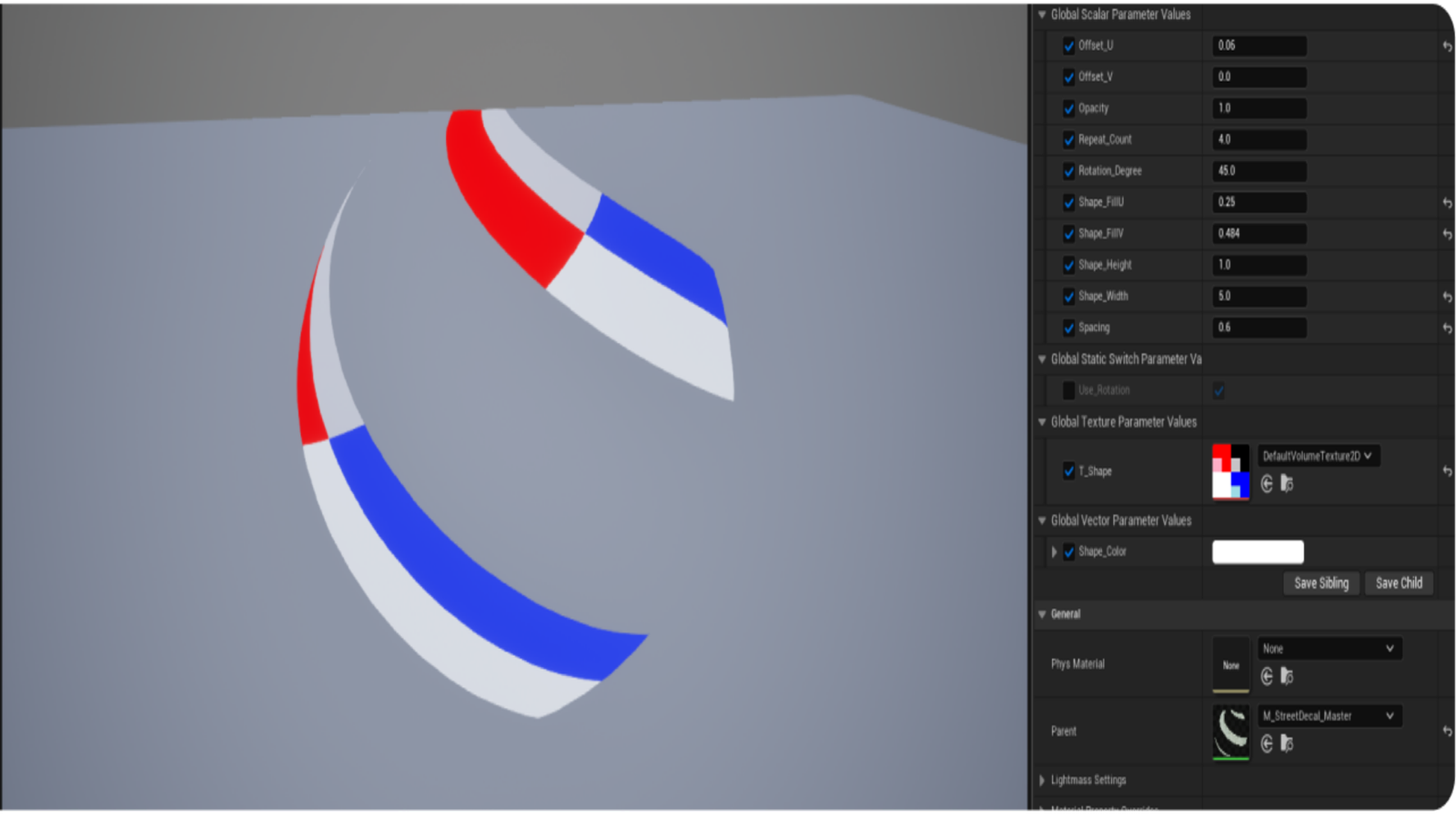
Materials & Shading: Building a Modular Decal System for Urban Simulation
In large-scale simulation environments, surface detail defines realism.
Road markings.
Traffic signs.
Directional indicators.
They seem minor but across an entire city, they become a major production challenge.
Recreating them manually leads to inconsistency, slow iteration, and unnecessary technical debt.
To solve this, we developed a modular decal material system designed specifically for road markings and traffic signage inside a real-time urban simulation.
The Core Objective
The goal wasn’t just visual accuracy.
It was system-level control.
We needed a solution that would:
- Enable fast iteration during development
- Maintain consistent visual rules across the city
- Support scalability for expanding environments
- Preserve performance across large simulation scenes
System Architecture
Instead of treating each marking or sign as a unique asset, we centralized visual logic inside a modular material framework.
This allowed:
- Parameter-driven color adjustments
- Flexible opacity and wear control
- Consistent edge definition and blending
- Standardized decal behavior across surfaces
Design variations could be handled through exposed material parameters rather than duplicating textures.
Performance & Scalability
Urban simulations operate at scale.
Thousands of decals may exist within a single scene.
The system was optimized to:
- Minimize shader complexity
- Reduce redundant texture usage
- Maintain surface fidelity at distance
- Remain performant across the entire city environment
High-fidelity visuals were preserved
without compromising real-time performance.
Production Impact
This modular decal approach improved more than visuals.
It streamlined development.
Iteration became faster.
Visual consistency became automatic.
Scalability became predictable.
Instead of managing hundreds of isolated assets, we managed a unified material system.
And in simulation development, system thinking is what keeps complexity under control.
